
The explosion of artificial intelligence, massive language models, and advanced high performance computing has exposed a critical bottleneck in modern data centers: the Memory Wall. For decades, server architecture has been rigid and monolithic. Upgrading memory capacity meant buying more CPUs simply to gain access to their direct attached memory channels, leading to immense cost inefficiencies and wasted compute cycles.
As we navigate the enterprise infrastructure landscape in 2026, the strategy for scaling data centers is undergoing a fundamental shift. Rather than scaling up isolated boxes, engineers are disaggregating components across high speed fabrics. The ultimate catalysts enabling this shift are two tightly intertwined technologies: PCI Express (PCIe) Generation 6 and the Compute Express Link (CXL) 3.1 standard. Together, they are tearing down the boundaries of the traditional server chassis to create highly elastic, composable infrastructures.
In this guide
1. The Physics of Speed: A Deep Dive into PCIe Gen 6
To understand how server architecture is changing, we must first look at the physical highways carrying the data. Released by the PCI-SIG, the PCIe 6.0 specification represents one of the most drastic architectural overhauls in the interconnect’s history. Its primary achievement is doubling the bandwidth of PCIe 5.0 to a raw data rate of 64 GigaTransfers per second (GT/s). In a standard high end server with x16 slots, this translates to 128 GB/s in a single direction, or a staggering 256 GB/s of bidirectional throughput.
The Shift from NRZ to PAM4 Signaling
Doubling the data rate every generation traditionally required increasing the signaling frequency. However, simply doubling the frequency from PCIe 5.0 to hit 64 GT/s would have resulted in a Nyquist rate of 32 GHz. At that frequency, the signal loss across the copper channels of a standard motherboard would be catastrophic, requiring expensive new materials and drastically shorter trace lengths.
To solve this, PCIe 6.0 abandons traditional Non Return to Zero (NRZ) encoding in favor of Pulse Amplitude Modulation 4-level (PAM4). PAM4 introduces four distinct voltage levels, allowing the channel to transmit two bits per unit interval instead of one. This brilliant engineering compromise allows PCIe 6.0 to achieve 64 GT/s while keeping the Nyquist rate pinned at 16 GHz, maintaining the same channel reach and physical footprint as PCIe 5.0.
Conquering the Error Rate with FLITs and FEC
While PAM4 solves the channel loss problem, packing four voltage levels into the same electrical envelope drastically reduces the signal eye width and height. The tighter margins make the receiver highly susceptible to noise, increasing the Bit Error Rate (BER) by several orders of magnitude.
To compensate for this noisy physical layer while preserving strict latency requirements, PCIe 6.0 implements a fundamental shift in how data is packaged: the Flow Control Unit (FLIT).
Instead of variable length packets, data is now transmitted in fixed 256-byte FLITs. This fixed sizing allows the protocol to apply a highly efficient, lightweight Forward Error Correction (FEC) mechanism. The 256-byte FLIT is broken down into specific components:
- 236 Bytes: Transaction Layer Packets (TLPs)
- 6 Bytes: Data Link Layer Packets (DLPs)
- 8 Bytes: Cyclic Redundancy Check (CRC)
- 6 Bytes: Error Checking and Correcting (ECC) data for the FEC
The FEC code is mathematically structured with a 3-way interleave, ensuring that even if a burst error wipes out up to 16 consecutive bits on a lane, the system can correct it on the fly. Combined with the strong 8-byte CRC, this architecture achieves absolute data reliability with a latency penalty of less than two nanoseconds, which is a crucial metric for direct memory access.
2. Architectural Evolution: PCIe 5.0 vs PCIe 6.0
Explore the precise technical leaps that distinguish the new generation of server fabrics.
3. Overcoming the Memory Wall: The Rise of CXL
PCIe 6.0 provides the raw, high bandwidth pipe, but to truly transform server architecture, the data center needs a smarter way to manage the traffic flowing through that pipe. This is where Compute Express Link (CXL) enters the equation.
CXL is an open industry standard interconnect that sits directly on top of the PCIe physical layer. It leverages the 64 GT/s PAM4 and FLIT architecture of PCIe 6.0 to facilitate highly optimized, cache coherent communication between the host CPU and attached devices like GPUs, SmartNICs, and dedicated memory modules.
The protocol operates using three distinct sub protocols multiplexed together:
- CXL.io: Handles discovery, configuration, and standard input/output.
- CXL.cache: Allows an accelerator to cache host memory securely and coherently.
- CXL.mem: Allows a host CPU to access the memory of an attached device as if it were local RAM.
From Direct Attach to Multilevel Fabrics
While earlier CXL versions allowed servers to expand their local memory capacity beyond standard motherboard DIMM slots, the introduction of the CXL 3.1 specification has completely redefined rack scale engineering.
CXL 3.1 introduces robust support for multilevel switching and Global Fabric Attached Memory. In this topology, memory is completely decoupled from the compute nodes. Instead of isolating RAM inside individual server chassis, memory modules are housed in dedicated enclosures and connected via top of rack CXL switches to a massive, shared fabric.
This leap introduces two paradigm shifting capabilities for the 2026 data center:
- Memory Pooling: A Fabric Manager dynamically allocates distinct blocks of remote memory to different servers based on real time demand. While the memory block resides on a shared chassis, it is logically dedicated to a single host for a given interval, maintaining strict security and isolation.
- Peer to Peer Sharing: CXL 3.1 enables accelerators (like clusters of AI GPUs) to bypass the CPU entirely, sharing memory spaces and communicating directly with each other. This drastically cuts down the latency tax that traditionally bottlenecked AI training clusters.
4. Architecting the 2026 Disaggregated Data Center
The marriage of PCIe 6.0 bandwidth and CXL 3.1 coherence is fundamentally changing how infrastructure engineers design and provision high end dedicated servers. The traditional server is being replaced by what is known as Composable Infrastructure.
Eradicating Stranded Memory
In conventional hosting and colocation deployments, a server might be purchased with one Terabyte of expensive DDR5 RAM. If the workloads running on that machine are highly compute intensive but have a small memory footprint, hundreds of Gigabytes of that RAM might sit idle. Because it is physically soldered or slotted into that specific motherboard, that unused capacity is stranded. Another server in the same rack might be starved for memory, forcing the organization to purchase an entirely new node.
With CXL memory pooling over a PCIe 6.0 fabric, stranded memory is practically eradicated. Memory is treated as a fluid resource. If a specific node suddenly requires additional RAM to process an in memory database query or load a massive AI model, the Fabric Manager instantly provisions it from the central pool. When the job is done, the memory is relinquished back to the pool for another node to use. This operational elasticity drastically improves total rack utilization and slashes Total Cost of Ownership.
Tiered Memory for AI Workloads
The latency gap between local, direct attached DDR5 RAM and NVMe Solid State Drives is roughly three orders of magnitude. This gap creates devastating processing delays when an AI processor runs out of main memory.
CXL creates a highly efficient secondary memory layer. Modern server architectures now tier their memory dynamically:
- Tier 0: Extremely fast, ultra low capacity High Bandwidth Memory (HBM) integrated directly on the GPU.
- Tier 1: Standard DDR5 directly attached to the host CPU for latency critical application logic.
- Tier 2: Massive, scalable CXL memory pools running over PCIe 6.0.
This tiering allows AI models that exceed local memory limits to gracefully overflow into the CXL pool without suffering the catastrophic performance penalties associated with paging out to standard NVMe storage.
The Future is Fabric
The era of monolithic server design is rapidly drawing to a close. As the processing demands of artificial intelligence and heterogeneous computing continue to escalate, brute forcing performance by cramming more components into a single box is no longer economically or thermally viable.
PCIe Gen 6 has provided the physical foundation by leveraging PAM4 signaling and ultra low latency error correction to push data at immense speeds without melting the motherboard. Layered on top, CXL 3.1 provides the intelligence, unlocking cache coherent fabrics, dynamic memory pooling, and hardware level acceleration. Together, they are transforming data centers into fluid ecosystems, ensuring that today's hardware can break the memory wall and conquer the workloads of tomorrow.
Ready for Next Gen Architecture?
Explore our enterprise grade dedicated servers built on cutting edge PCIe and CXL architectures. Scale your memory and compute dynamically to meet the demands of tomorrow.
Recent Topics for you

DDoS Protection for Gaming Servers: Layer 7 Security Guide
Learn how to protect dedicated gaming servers from Layer 7 DDoS attacks with network mitigation, rate limiting, firewalls, server hardening, and monitoring.
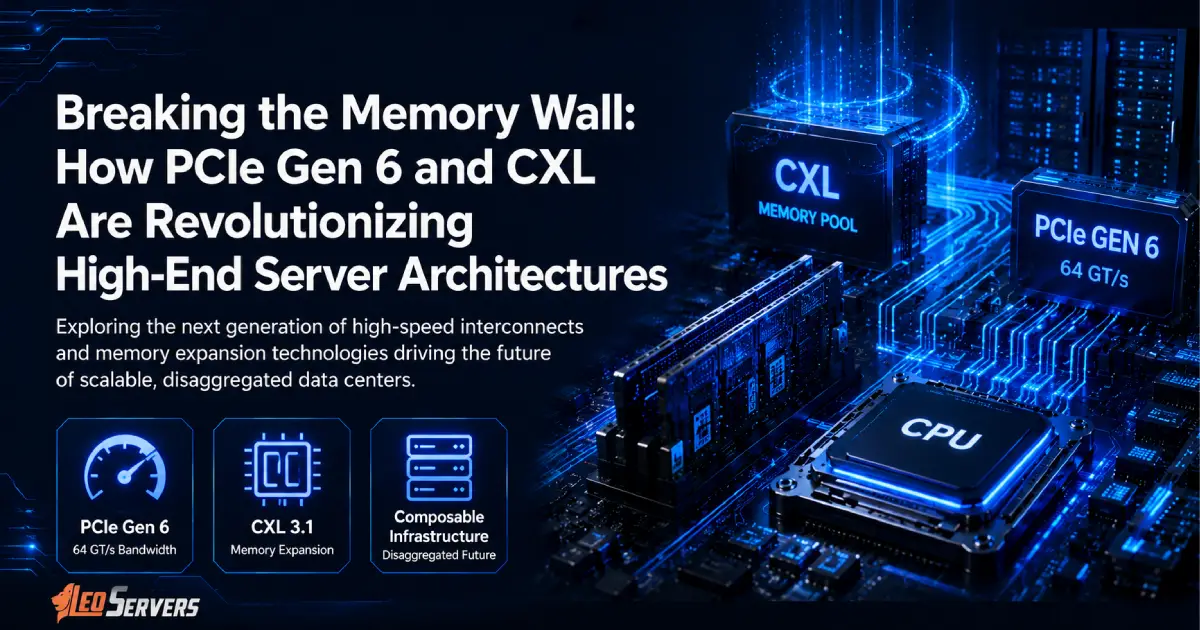
PCIe Gen 6 & CXL 3.1: Revolutionizing Server Architectures
Discover how PCIe Gen 6 and CXL 3.1 are breaking the memory wall. Explore composable infrastructure, tiered memory, and high bandwidth server architectures.

Why Your WooCommerce Store Needs a Dedicated Server
Is slow hosting killing WooCommerce conversions? Discover why a dedicated server offers the speed and uptime your store needs.

Why Liquid Cooling Is Mandatory for High-End Dedicated Server Racks
Discover why air cooling has hit its thermodynamic limit at 41.3 kW and how direct-to-chip liquid cooling and immersion cooling power modern AI data centers.

How to Choose the Right Dedicated Server Configuration
Picking a dedicated server is not a one-size-fits-all decision. Learn exactly which specs to prioritise, from CPU and RAM to bandwidth and location.

Why a USA Dedicated Server Is the Best Choice for Global Businesses
Discover why hosting your infrastructure on a USA dedicated server provides an unmatched competitive advantage, from tier 1 global peering to strategic locations across America.

Why a Dedicated Server in Germany Is Perfect for European Businesses
Discover why hosting your infrastructure on a German dedicated server provides an unmatched competitive advantage, from DE-CIX routing to strict GDPR and BDSG compliance.

Unmetered Bandwidth Dedicated Servers: Why Gamers & Streamers Need Them
Discover why unmetered bandwidth dedicated servers are essential for gaming and live streaming. Learn how bare-metal infrastructure prevents lag, throttling, and data overage fees.

The Ultimate Guide: Why NVIDIA L40S GPU Is the Best GPU for Video Rendering in 2026
Looking for the best GPU for video rendering in 2026? Learn why the NVIDIA L40S dominates 3D animation, VFX, and AI video workflows, and how Leo Servers can power your pipeline.

Best Dedicated Server Locations for Game Hosting in 2026
Discover the best dedicated server locations for game hosting worldwide. Leo Servers breaks down which regions deliver the lowest ping, highest uptime, and the best gaming experience for players across every continent.

Top 10 Open-Source AI Models for Dedicated GPU Servers
Discover the top 10 open-source AI models for 2026 and the dedicated GPU servers required to host them. Reduce API costs and ensure data privacy.

What Is an Unmetered Dedicated Server & Who Should Use One?
Discover what an unmetered dedicated server is, how it works, and whether your business needs one. Leo Servers explains port speeds, bandwidth, and who benefits most.

The Infrastructure Behind AI: Why LLMs Require Bare Metal GPUs
Discover why bare metal GPU servers are critical for running Large Language Models, conquering VRAM constraints, and maximizing inference throughput.
AMD EPYC 9355P: The Powerhouse Dedicated Server You Need
Discover why the AMD EPYC 9355P 'Turin' Zen 5 processor is the ultimate choice for dedicated servers needing 32 cores and massive L3 cache.

Why Singapore Dedicated Servers Are in High Demand in 2026
Explore why Singapore dedicated servers are in high demand in 2026 for gaming and enterprise workloads needing ultra-low APAC latency.
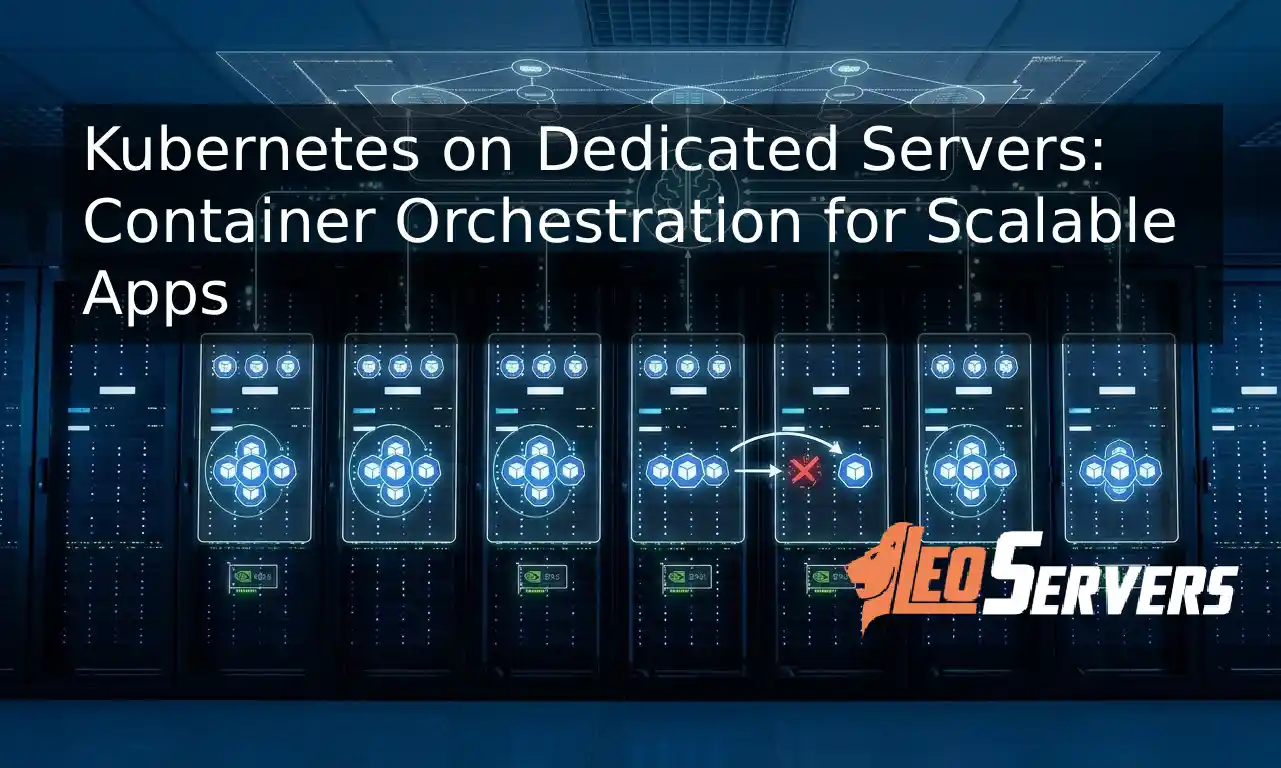
Kubernetes on Dedicated Servers: Container Orchestration for Scalable Apps
Discover why running Kubernetes on dedicated bare metal servers offers the ultimate container orchestration for scalable apps without cloud virtualization overhead.

AIOps: The Future of AI-Powered Server Management
Discover how AIOps is reinventing server management with predictive maintenance, automated optimization, and self-healing infrastructure. Learn more at Leo Servers.

Top 5 Locations For Dedicated Server Hosting in 2026
Choosing the right dedicated server location is critical for speed and compliance. Explore the top 5 global hosting locations for 2026, including the USA, Germany, and Singapore.
![5 Top Dedicated GPU Server Providers [2026]](/assets/images/blog/top-5-gpuproviders.webp)
5 Top Dedicated GPU Server Providers [2026]
A dedicated GPU server delivers consistent, predictable performance for AI and rendering. We examine leading providers including Leo Servers, OVHcloud, and Hetzner.

Why a Dedicated Server in Mumbai is the Key to High-Performance & Low Latency Hosting
Migrating to a Dedicated Server in Mumbai offers the robust backbone required for modern applications. Discover why local infrastructure is the key to conquering latency.

15 Best Games with Bare Metal Dedicated Servers: The Pro-Gamer’s Choice for 2026
True performance enthusiasts know that Bare Metal Dedicated Servers are the only way to achieve zero-latency. Explore the top 15 titles demanding dedicated hardware in 2026.
Is the GeForce RTX 5090 Good for Gaming? User Reviews 2026
Thinking about upgrading your rig or server infrastructure in 2026? The NVIDIA GeForce RTX 5090 has officially cemented itself as the titan of the Blackwell generation.

5 Best GPU Server Providers for AI Training in 2026
Discover why Russia Dedicated Servers are the low-latency solution for conquering the CIS market.

Why Russia Dedicated Servers Are Your Secret Weapon for CIS & Asian Markets
Discover why Russia Dedicated Servers are the low-latency solution for conquering the CIS market.

Why Your Business Needs a Dedicated Server in Brazil
Localized Hosting for Global Reach: Conquer the Latin American Market

Why France is the Ultimate Destination for Dedicated Servers
Lightning-Fast, Secure, and Scalable Dedicated Servers for Global Business. Key Advantages for Businesses Worldwide.

Why a Japan Dedicated Server is Your Business's Next Strategic Move
Discover the key advantages of a Japan dedicated server. From low-latency access to the entire Asia-Pacific market to high-performance GPU capabilities, see why Japan is the strategic choice for your infrastructure.

Blog Post Title: The APAC Advantage: Why Your Next Australia Dedicated Server Should Be with Leo Servers
Discover the strategic advantages of Australia dedicated servers for APAC markets. Lightning-fast latency, robust security, and enterprise-grade infrastructure with Leo Servers.

Boost Website Speed & Fix Memory Errors: How to Increase PHP Memory Limit in WHM
Fix 'Allowed memory size exhausted' errors and speed up your websites on Leo Servers by increasing the PHP memory limit in WHM. Learn step-by-step with expert tips.
1