
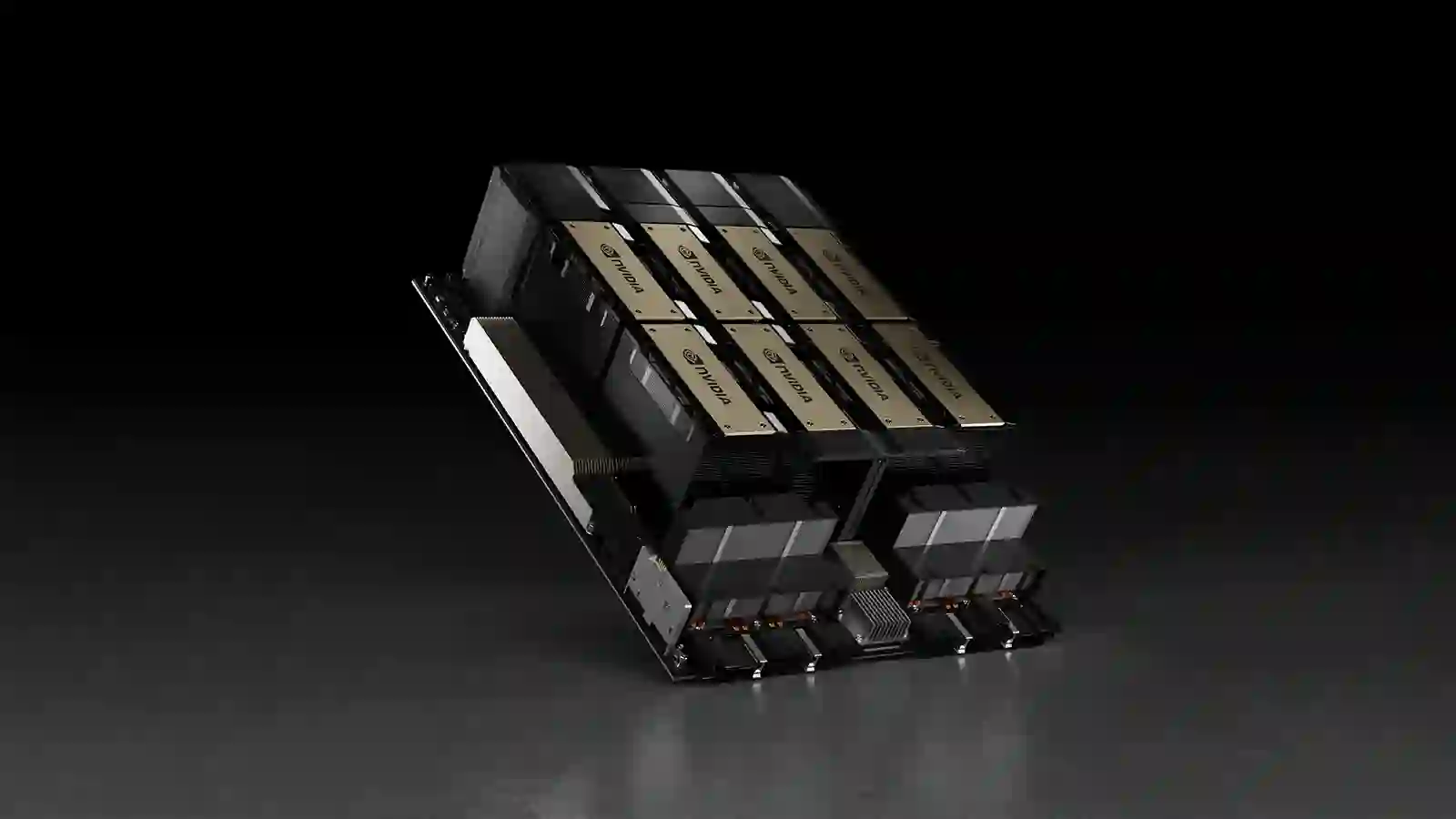
Nvidia H100 Dedicated Servers: The Standard for LLM Training & Generative AI
Dominate the 2026 AI landscape with the world's most advanced tensor core GPU. The Nvidia H100 is not just hardware; it is the engine behind the world's most powerful Large Language Models (LLMs). Built on the Hopper architecture, our dedicated H100 servers deliver up to 9x faster AI training and 30x faster inference than previous generations, making them the critical infrastructure for organizations scaling intelligence.
Configuration Options & Deployment Flexibility
Dedicated H100 servers come in multiple configurations to match your workload and budget requirements. Our platform offers flexible CPU-to-GPU ratios, memory configurations, and NVLink topologies.
Single GPU Configuration
Ideal for: Inference-heavy workloads, model serving, experimentation
Specs: 1x H100 GPU, 256GB+ system RAM, 2x Xeon Platinum 8592+ CPU
Use Case: API endpoint serving, micro-batch inference, model testing
Network: 100Gbps RoCE or Ethernet for integration
Dual GPU Configuration (NVLink Connected)
Ideal for: Small-scale training, multi-model serving, hybrid inference/training
Specs: 2x H100 GPUs, 768GB system RAM, 4x Xeon Platinum 8592+ CPU
Performance: 2x linear scaling with NVLink 4.0 direct GPU-to-GPU communication
Use Case: Fine-tuning 7B-13B models, serving multiple models simultaneously
8x GPU Cluster Configuration (Full NVLink Topology)
Ideal for: Enterprise training, production inference at scale, research labs
Specs: 8x H100 GPUs, 2TB system RAM, dual-socket Xeon Platinum CPU
Performance: Full fabric scaling with <1.5% communication overhead
Network: 400Gbps Infiniband or 200Gbps Ethernet for multi-node clusters
Typical Deployment: 2-8 nodes for distributed training of 100B+ parameter models
Customization Options
Storage
NVMe SSD (14TB-28TB) or SAN/NAS integration
Networking
Mellanox InfiniBand HDR200, Nvidia BlueField SmartNIC, or standard 100Gbps Ethernet
Cooling
Liquid or air-cooled facilities in enterprise-grade data centers
Redundancy
Hot-swap GPU cards, redundant power supplies, automatic failover
The Specs: Hopper Architecture Deep Dive
The H100 is engineered to solve the bottleneck of memory bandwidth in massive datasets.
Architecture
Nvidia Hopper (4nm)
Memory
80GB HBM3
Throughput
3.35 TB/s
AI Compute
4th-Gen Tensor
Interconnect
900 GB/s NVLink
Key Feature
MIG (7 Instances)
Best For: Massive Scale AI Workloads
Training Foundation Models
The only viable choice for training 175B+ parameter models (like GPT-4 or Llama 3 variants) from scratch
Real-Time LLM Inference
Delivers lowest latency for chatbots handling millions of concurrent tokens
Scientific Computing (HPC)
Accelerates genome sequencing, fluid dynamics, and climate modeling by 7x compared to the A100
Mixture of Experts (MoE) Models
High memory bandwidth eliminates bottlenecks in complex, sparse AI models
H100 Performance Comparison
How the H100 stacks up against the previous generation.
| Feature | Nvidia H100 | Nvidia A100 | Delta |
|---|---|---|---|
| FP8 Tensor Core | 3,958 TFLOPS | N/A | Infinite |
| FP16 Tensor Core | 1,979 TFLOPS | 312 TFLOPS | ~6x Faster |
| Memory BW | 3.35 TB/s | 2.0 TB/s | 1.6x Faster |
| LLM Training | 9x Speedup | Baseline | H100 Wins |
Server Configurations & Scalability
We offer H100s in configurations designed to maximize PCIe Gen5 and NVLink speeds.
Single Node (1x H100)
For fine-tuning mid-sized models and heavy inference
HGX H100 (4x or 8x Cluster)
Interconnected via NVLink for massive model training
Networking
Paired with dual 100GbE or InfiniBand uplinks to ensure data feeds never stall the GPU
Storage
NVMe SSD (14TB-28TB) or SAN/NAS integration
Networking
Mellanox InfiniBand HDR200, Nvidia BlueField SmartNIC
Cooling
Liquid or air-cooled facilities in enterprise-grade data centers
Redundancy
Hot-swap GPU cards, redundant power supplies
Technical FAQ: Nvidia H100
Common architectural and operational questions for deployment.
Can I use NVLink with H100 PCIe GPUs?
No. NVLink requires SXM form-factor GPUs. PCIe H100s communicate via PCIe 5.0 (128 GB/s), which is sufficient for data parallelism but insufficient for tensor parallelism. Always choose SXM for multi-GPU clusters.
What's the difference between H100 80GB and smaller variants?
The standard H100 includes 80GB HBM3 memory. Some older offers included 40GB variants, but these are discontinued. The 80GB model is the current standard across all cloud and on-premise deployments.
Can I run inference-only workloads on H100?
Yes, but it's typically not cost-effective for single-model serving. The H100 shines when serving 7+ models simultaneously (via MIG partitioning) or handling extreme throughput (1000s of requests/second). For single-model inference, the L40S is more cost-efficient.
How does H100 compare to consumer GPUs like the RTX 4090?
The H100 is 4–6x faster for LLM training and 2–3x faster for inference, but costs 8–10x more. The RTX 4090 is excellent for development and small-scale inference; H100 is required for production-scale systems.
What operating systems are supported?
Linux (Ubuntu 22.04 LTS recommended), AlmaLinux, Rocky Linux. Windows Server is available but not recommended for deep learning workloads.
Can I access these servers from my local machine?
Yes. You receive SSH access (Linux/Mac) and SSH/RDP access (Windows). We also provide Jupyter Lab access for interactive development and direct SFTP for file transfer.